

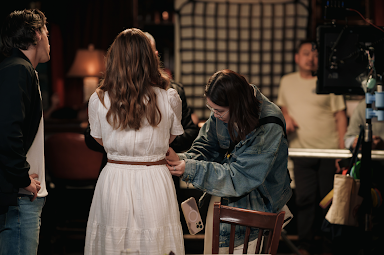
Los Angeles, CA — Costume design is increasingly being recognized as a core storytelling mechanism within short-form screen productions, as cross-cultural methodologies introduce new levels of visual precision and narrative clarity. Work developed by costume designer and fashion art director Yiwen Yu reflects this shift, positioning wardrobe as an integrated narrative system shaped by character development, cultural context, and audience interpretation.
Recent short-form productions illustrate the application of this approach within high-engagement digital formats. Surrender to My Dangerous Boss has been associated with approximately 30.5 million views on ReelShort, while Daisy in the Gun’s Chamber has recorded more than 100,000 active viewers on NetShort and has been released in French, Italian, and Portuguese, indicating broader international accessibility across multiple viewing regions.
This design methodology is structured around a full-cycle process that begins at script analysis and continues through on-set execution and post-production coordination. Each phase is treated as a critical component in maintaining continuity, visual coherence, and narrative accuracy.
The process begins with a detailed breakdown of each script, mapping character background, emotional trajectory, and social positioning. These elements are translated into visual frameworks through the development of mood boards and costume lookbooks. Core design components—including color palette, silhouette, fabric selection, and period references—are defined to communicate both external identity and underlying character dynamics.

Creative alignment is achieved through iterative refinement of visual direction to ensure consistency with narrative intent. Costume design decisions are evaluated based on clarity of storytelling, with each visual element required to support character readability on screen.
Following conceptual development, the process advances into sourcing and preparation. Garments are selected, modified, or constructed according to established visual frameworks. Fittings function as a key evaluation stage, assessing not only physical fit but also performance under camera conditions and alignment with character presence. Detailed documentation is maintained throughout, forming a structured continuity system for fast-paced production schedules.
On-set execution emphasizes precision and adaptability. Short-form productions often require rapid scene transitions, making consistency and accuracy essential. Continuous monitoring of costume detail ensures alignment across scenes, while immediate problem-solving supports uninterrupted production flow when unforeseen challenges arise.
Post-production procedures extend the methodology beyond filming. Inventory verification, garment condition assessment, and preparation for subsequent production phases contribute to long-term continuity and operational reliability, particularly in multi-phase projects.
In parallel with screen-based work, editorial projects have explored the translation of conceptual themes into visual form. Published work includes the cover feature of 17:23 Magazine (November 2023), as well as features in L’Amour Magazine (October 2024) and PAP Magazine (January 2025). These projects further examine costume and styling as tools for visual communication within broader cultural and thematic contexts.
Cross-market production experience has informed a dual-framework approach to visual storytelling. Differences in symbolic interpretation, audience expectations, and stylistic conventions across regions require adaptive design strategies. Costume elements are reinterpreted to maintain narrative clarity and cultural relevance across diverse viewing environments, rather than directly transferred between contexts.
As short-form digital content continues to expand globally, the role of costume design is evolving toward a more structured and narrative-focused discipline. The work of Yiwen Yu reflects this ongoing shift, demonstrating how visual design systems can support storytelling with precision, consistency, and cross-cultural adaptability.