

Many people first hear about crypto mining through stories from the early Bitcoin days. Someone left a laptop running overnight and mined coins that later became worth thousands of dollars. While those early opportunities are mostly gone, mining itself has not disappeared. It has simply evolved into a more mature industry where both individuals and large data centers participate in securing blockchain networks.
Today, mining ranges from small home setups to massive facilities filled with specialized machines. Beginners still enter the space every day and often ask the same question: What is the easiest crypto to mine today?
The answer depends on several things. The hardware you already own matters. Electricity costs play a huge role. The total number of miners competing on a network also affects how difficult it is to earn rewards. Some coins remain accessible with GPUs or even CPUs, while others require specialized ASIC miners that look more like servers than personal computers.
This guide explores ten cryptocurrencies that remain relatively accessible to mine in 2026, explains how mining works in practice, and shows real examples of how people approach mining today.
What Crypto Mining Actually Means
Crypto mining is the process that allows many blockchain networks to function without a central authority. When users send cryptocurrency transactions, those transactions must be verified and recorded in blocks. Miners provide the computational power that confirms these blocks.
The process involves solving complex mathematical problems using hardware. Once a miner successfully validates a block, the network rewards them with newly issued cryptocurrency.
For example, the Bitcoin network currently distributes about 3.125 BTC as a block reward. Litecoin distributes around 6.25 LTC. Smaller cryptocurrencies often produce blocks faster and distribute smaller rewards more frequently.
Mining, therefore, performs three core roles at the same time.
- Transaction verification
- Network security
- Distribution of new coins
Why Beginners Search for the Easiest Crypto to Mine
Most beginners searching for easy crypto mining coins are trying to answer a simple question: Can I start mining without spending tens of thousands of dollars?
Imagine a beginner named Daniel who owns a gaming PC with a modern graphics card. After watching several mining tutorials online, he installs mining software and starts mining Ravencoin overnight while the computer is idle. Each day, the rewards are small, but over time, he accumulates a steady amount of coins.
Many miners actually start this way.
However, experienced miners evaluate several factors before choosing a coin.
- Electricity price
- Network hashrate
- Mining difficulty
- Hardware efficiency
- Market value of the cryptocurrency
A coin may be technically easy to mine, but if electricity costs are high, it may not be profitable. Successful miners always calculate these variables before investing in hardware.
Overview of the Easiest Cryptocurrencies to Mine in 2026
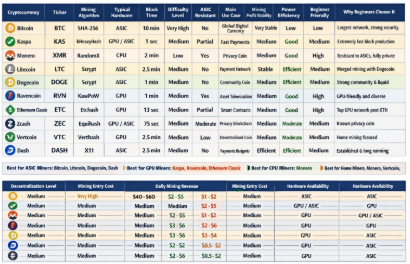
This table highlights ten cryptocurrencies that remain relatively accessible for mining in today’s market. Each network uses a different mining algorithm and hardware type, offering opportunities for beginners depending on the equipment they have available.
Bitcoin remains the most established option. It uses the SHA-256 algorithm and specialized ASIC miners, with a 10-minute block time and high difficulty. While entry costs are higher, the network is extremely stable and supported by the largest mining ecosystem.
Kaspa has gained attention because of its extremely fast 1-second block time. It uses the kHeavyHash algorithm and can be mined with GPUs or ASICs. Its medium difficulty and high block frequency make it attractive for modern miners.
Monero focuses on decentralization and privacy. It uses the RandomX algorithm, which is designed for CPU mining and actively resists ASIC hardware. With a relatively low difficulty and a 2-minute block time, it remains one of the most accessible networks for individual miners.
Litecoin uses the Scrypt algorithm and is mined with ASIC devices. Its 2.5-minute block time and medium difficulty make it a stable and long-standing mining option. One of its advantages is merged mining with Dogecoin.
Dogecoin also uses the Scrypt algorithm and benefits from merged mining with Litecoin. With a 1-minute block time, strong community support, and high liquidity, it remains a popular mining target.
Ravencoin was designed with GPU miners in mind. Using the KawPoW algorithm and producing blocks every minute, it maintains a balanced difficulty level and continues to attract miners using graphics cards.
Ethereum Classic became a major destination for GPU miners after Ethereum moved to proof-of-stake. It runs on the Etchash algorithm with 13-second block times and medium difficulty, providing consistent opportunities for GPU mining.
Zcash focuses on privacy and uses the Equihash algorithm. It supports both GPUs and ASIC miners and produces blocks approximately every 75 seconds, offering flexibility for different types of hardware.
Vertcoin is designed to maintain decentralization by remaining GPU-friendly. Using the Verthash algorithm and having relatively low mining difficulty, it aims to keep mining accessible for smaller participants.
Dash uses the X11 algorithm and ASIC miners. With a 2.5-minute block time and a well-established network, it continues to operate as a mature cryptocurrency with an active user base.
Overall, these cryptocurrencies represent different entry points for miners. CPU miners often choose Monero, GPU miners tend to focus on Ravencoin, Ethereum Classic, or Vertcoin, while ASIC miners dominate networks such as Bitcoin, Litecoin, Dogecoin, and Dash.
Real Example of Home GPU Mining
Consider a typical gaming computer with an RTX 3060 graphics card. Many gamers already own this hardware. Instead of leaving the GPU unused overnight, the owner can run mining software to mine coins such as Ravencoin or Ethereum Classic.
Depending on electricity costs and network conditions, the miner might earn a small amount of cryptocurrency each day. While the daily income may not seem impressive, many miners treat the coins as a long-term accumulation strategy. If the value of the coin increases in the future, the mined assets can become significantly more valuable.
This is similar to slowly accumulating shares in a company or saving money in a long-term investment portfolio.
Example of Industrial ASIC Mining
Large-scale mining looks very different from home setups.
Instead of gaming GPUs, industrial miners use ASIC machines designed specifically for one algorithm. A modern Bitcoin miner, such as the Antminer S21, can produce more than 200 TH per second while consuming several thousand watts of electricity.
Because these machines generate large amounts of heat and noise, they are rarely operated in residential environments. Instead, they run in specialized mining farms where electricity is cheaper and cooling infrastructure is optimized.
For example, some mining facilities operate in regions where electricity costs below 0.05 USD per kilowatt hour. Under those conditions, large mining operations become economically viable.
Many individual investors now participate through hosted mining infrastructure rather than running machines at home.
Hardware Used for Crypto Mining
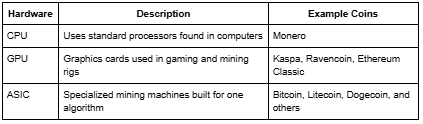
Mining equipment generally falls into three categories.
CPU mining is the easiest entry point since anyone with a computer can try it. GPU mining offers flexibility because graphics cards can mine different algorithms. ASIC miners provide the highest performance but are dedicated to one specific algorithm.
Calculating Mining Profitability
Before purchasing hardware, experienced miners always estimate potential earnings. Several online calculators help simulate profitability under different conditions.
Popular tools analyze factors such as machine hashrate, electricity price, network difficulty, and market price of the cryptocurrency.
For example, a miner paying 0.22 USD per kWh for electricity might struggle to stay profitable, while another miner operating in a region with electricity below 0.07 USD per kWh could run the same hardware successfully.
Because of these differences, location plays a huge role in mining economics.
Mining at Home vs Mining Hosting
Running mining hardware at home can work for small setups, but it quickly becomes challenging when machines scale. ASIC miners produce significant heat and noise and require a stable electricity infrastructure.
For this reason, many miners choose professional hosting facilities where machines run inside specialized data centers. These facilities typically offer lower electricity costs, optimized cooling systems, and remote monitoring tools.
Some mining platforms, such as Oneminers, provide infrastructure that allows users to purchase ASIC machines, host them in different international locations, monitor performance through a mobile app, and even estimate profitability using built-in calculators. For beginners, this approach removes many of the technical challenges associated with running mining equipment at home.
Is Crypto Mining Still Worth It in 2026
Mining profitability in 2026 depends less on luck and more on efficiency and planning. The industry has matured, and competition has increased, but opportunities still exist for miners who carefully analyze costs.
New hardware continues to improve energy efficiency. Mining farms are expanding into regions with renewable energy sources. At the same time, new blockchain projects continue to appear with algorithms designed to remain accessible to smaller miners.
Many experienced miners view mining not only as an immediate income but also as a way to accumulate cryptocurrency gradually over time.
Conclusion
Crypto mining in 2026 is no longer the wild frontier it was in the early Bitcoin days, but it remains a powerful and accessible way to participate in the blockchain economy. The key difference today is that success in mining depends more on strategy, efficiency, and choosing the right hardware rather than simple luck.
For beginners, coins such as Monero, Kaspa, Ravencoin, Vertcoin, and Ethereum Classic offer relatively low barriers to entry and can often be mined with CPUs or GPUs that many users already own. These networks allow newcomers to experiment with mining without immediately investing in expensive equipment.
At the same time, large-scale mining continues to grow through specialized ASIC hardware used for cryptocurrencies like Bitcoin, Litecoin, Dogecoin, and Dash. Professional mining farms and hosting facilities make it possible for individuals to participate in industrial-level mining without managing the hardware themselves.
Ultimately, the “easiest” cryptocurrency to mine is not defined by the algorithm alone. It depends on a combination of factors including electricity costs, hardware efficiency, network difficulty, and long-term market value of the coin. Miners who carefully evaluate these variables and think long-term often achieve the best results.
Even in a competitive market, mining remains one of the most direct ways to support decentralized networks while gradually accumulating cryptocurrency. Whether someone starts with a gaming PC at home or scales into hosted ASIC infrastructure, mining continues to offer both technological involvement and potential financial upside for those willing to approach it strategically.